
- Culture as the Air of Consciousness
- Our Position — Not Prohibition, but Balance
- Do Such Metrics Already Exist?
- Three Levels of Assessment — Narrow, Broad, and Jain
- Cinema — The Machine of Heroic Elimination
- Horror and Absolute Evil
- Not Only Watching, but Acting
- — A School of Health or a School of Zero-Sum Thinking?
- Music, Status, and Toxic Passions
- News and Social Media — Algorithmic Anxiety
- Superficial Inclusion Without Ethical Transformation
- The Degradation of Big Myths — Star Trek and Star Wars
- Neuroscience and Necessary Caution
- Gramsci, Cultural Hegemony, and the Matrix of Violence
- The Greatest Problem — The Absence of Peace Heroes
- Wrong Metrics of Culture
- What Is the Cultural Balance Index?
- Peaceful Design Label
- Annual Cultural Balance Report
- Possible Objections
- : Practical Direction for Peaceful World
Cultural Balance
How Mass Culture Normalizes Violence — and How We Restore a Culture of Peace
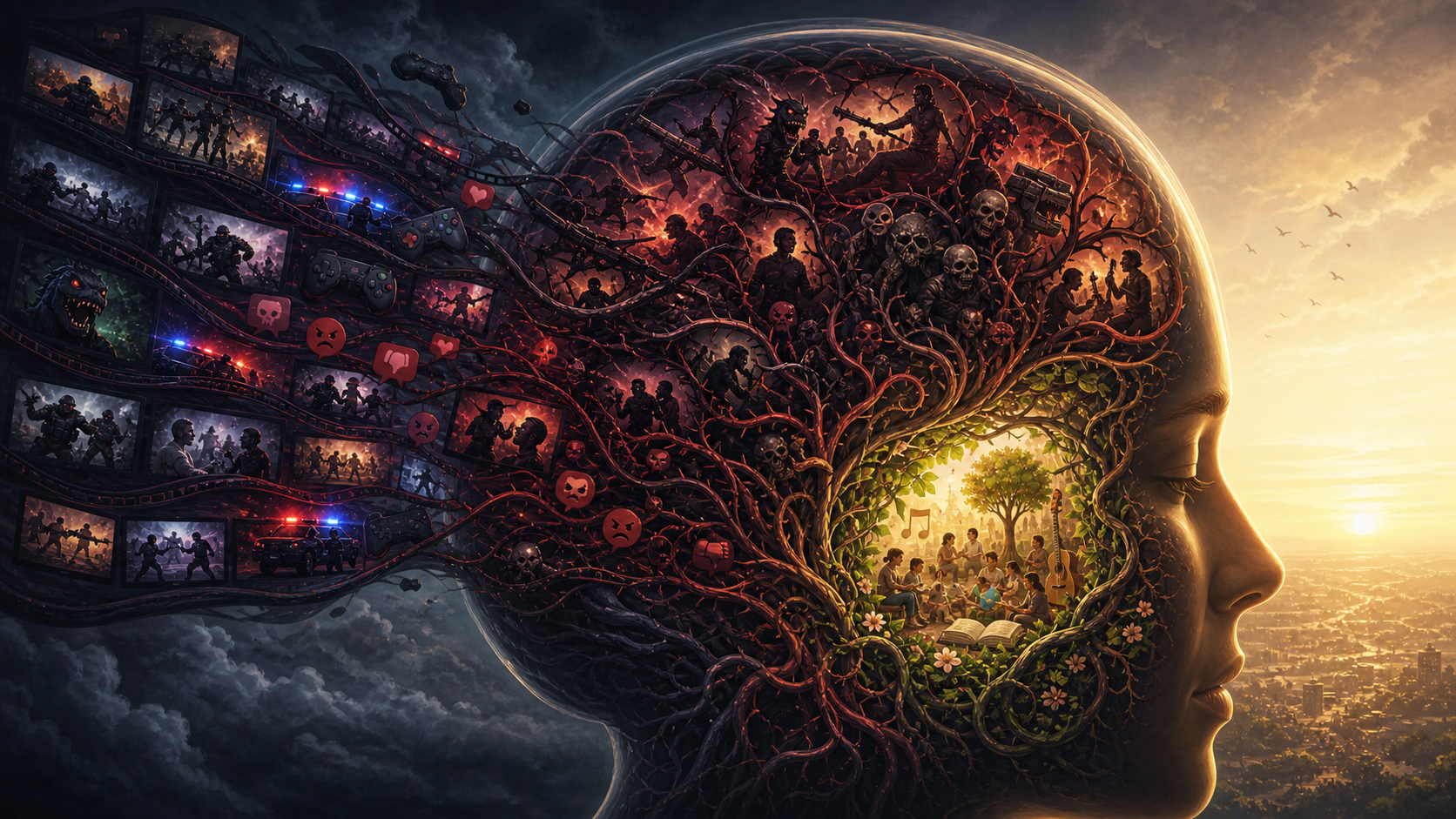
Culture as the Air of Consciousness
We are used to speaking about violence too narrowly. Usually, when a person hears the word “violence”, they imagine something obvious: a blow, a weapon, a war, a killing, a crime, physical suppression, a fight scene, blood, an explosion, a chase, a threat. But if we look deeper, violence does not begin only at the moment when the hand is already raised. It begins earlier. It begins in the mind. In intention. In the image of the other. In the habit of seeing the world as a battlefield. In the habit of thinking that a problem is solved by eliminating someone. In the habit of dividing people into “us” and “them”. In the habit of believing that victory over another is the main sign of strength.
This is why ancient traditions of nonviolence are so important for the modern discussion about culture. Especially the Jain tradition. The Jains can be understood as some of the most consistent researchers of violence and nonviolence in the history of civilization. Of course, they were not “scientists” in the narrow modern laboratory sense. They did not work with fMRI, big data, platform analytics, or media datasets. But for roughly two and a half thousand years they have been studying something that modern science is only beginning to examine systematically: how violence arises in consciousness, how it passes through speech, intention, social habit, economics, food, power, status, fear, attachment, and culture. From a Jain perspective, violence is not only an action. It is also an inner state that makes action possible.
If greed, pride, the desire to suppress, the desire to possess, the desire to rise above another, the desire to humiliate, or the desire to destroy are already present inside, then physical action is only the final stage of the process. It is the visible tip. The roots are deeper. And if violence begins in the mind, then culture is not merely entertainment. Culture becomes soil. It plants seeds. Seeds of fear. Seeds of hostility. Seeds of domination. Seeds of wanting to defeat another at any cost. Or, on the other hand, seeds of compassion, cooperation, responsibility, and peace. The main question of this study is simple: What kind of seeds does mass culture plant most often today? Seeds of peace? Seeds of trust? Seeds of compassion? Seeds of cooperation? Seeds of wisdom?
Or seeds of fear, domination, jealousy, revenge, status, hostility, objectification, and zero-sum thinking? Our conclusion is uncomfortable, but important: modern mass culture is strongly imbalanced. It is not entirely violent. That would be too crude and unfair. Culture contains beauty, humor, love, friendship, family, care, creativity, music, sport, play, science, education, childhood tenderness, religious searching, philosophy, art, and nature. But if we look specifically at the dominant visible background — at what is loudest, richest, most promoted, most discussed, and most amplified by industry, algorithms, and markets — we see a powerful tilt. This background is too often built around violence, threat, fear, domination, competition, absolute evil, zero-sum logic, and force as the solution to problems. And this is no longer only a matter of taste. It is a matter of cultural ecology.
This is why ancient traditions of nonviolence are so important for the modern discussion about culture. Especially the Jain tradition. The Jains can be understood as some of the most consistent researchers of violence and nonviolence in the history of civilization. Of course, they were not “scientists” in the narrow modern laboratory sense. They did not work with fMRI, big data, platform analytics, or media datasets. But for roughly two and a half thousand years they have been studying something that modern science is only beginning to examine systematically: how violence arises in consciousness, how it passes through speech, intention, social habit, economics, food, power, status, fear, attachment, and culture. From a Jain perspective, violence is not only an action. It is also an inner state that makes action possible.
If greed, pride, the desire to suppress, the desire to possess, the desire to rise above another, the desire to humiliate, or the desire to destroy are already present inside, then physical action is only the final stage of the process. It is the visible tip. The roots are deeper. And if violence begins in the mind, then culture is not merely entertainment. Culture becomes soil. It plants seeds. Seeds of fear. Seeds of hostility. Seeds of domination. Seeds of wanting to defeat another at any cost. Or, on the other hand, seeds of compassion, cooperation, responsibility, and peace. The main question of this study is simple: What kind of seeds does mass culture plant most often today? Seeds of peace? Seeds of trust? Seeds of compassion? Seeds of cooperation? Seeds of wisdom?
Or seeds of fear, domination, jealousy, revenge, status, hostility, objectification, and zero-sum thinking? Our conclusion is uncomfortable, but important: modern mass culture is strongly imbalanced. It is not entirely violent. That would be too crude and unfair. Culture contains beauty, humor, love, friendship, family, care, creativity, music, sport, play, science, education, childhood tenderness, religious searching, philosophy, art, and nature. But if we look specifically at the dominant visible background — at what is loudest, richest, most promoted, most discussed, and most amplified by industry, algorithms, and markets — we see a powerful tilt. This background is too often built around violence, threat, fear, domination, competition, absolute evil, zero-sum logic, and force as the solution to problems. And this is no longer only a matter of taste. It is a matter of cultural ecology.
Our Position — Not Prohibition, but Balance
It is important to say this immediately: we are not talking about prohibition. Peaceful World does not propose banning conflict in art. We do not propose abolishing dark stories. We do not propose removing tension from films. We do not propose eliminating sport. We do not propose banning games that involve struggle. And we do not propose turning culture into a sterile museum of “correct kindness”. That would be not only unrealistic, but wrong. Conflict is part of life. Tragedy is part of human experience. Fear is part of the psyche. Shadow is part of the soul. Drama is part of art. Risk, loss, choice, resistance, and protection can all be honest cultural material. The problem is not that culture contains conflict.
The problem is that conflict is too often presented in its most primitive form: there is an enemy; the enemy is absolute evil; we do not speak with it; we do not understand it; we do not heal it; we do not place it inside a more complex picture of causes; we destroy it. And the viewer, listener, player, or fan receives the same grammar again and again: threat — fear — mobilization — strike — victory — relief. This grammar works. It is powerful. It is ancient. It catches the nervous system. It is understandable to children, adults, markets, and algorithms. It gives a clear emotional contour. It sells. But it is not the only possible grammar of life. There is another grammar: threat — understanding the causes — de-escalation — restoration — balance — life continues.
And this second grammar is much less visible in mass culture. Our aim is not to remove the first grammar completely. Our aim is to restore equilibrium. The image of yin and yang is useful here. Yin and yang do not mean one side destroying the other. They do not mean the crude victory of light over darkness, or the victory of darkness over light. They mean balance between forces. Culture also needs such balance.
If there are action films, let there also be powerful stories of reconciliation. If there are games of elimination, let there also be games of restoration. If there is sport built around victory, let there also be sport built around health, beauty of movement, cooperation, and self-overcoming. If there are films about absolute evil, let there also be films about the causes of evil, trauma, restoration, and the prevention of violence. The problem today is that the balance is broken. Not slightly. Strongly.
That is why we speak not of censorship, but of cultural balance. Censorship asks: what should be forbidden? Cultural balance asks: what is missing? Censorship looks for an enemy. Cultural balance looks for proportion. Censorship can easily become a new form of violence. Cultural balance tries to see the system as a whole. This is a fundamental difference.
The problem is that conflict is too often presented in its most primitive form: there is an enemy; the enemy is absolute evil; we do not speak with it; we do not understand it; we do not heal it; we do not place it inside a more complex picture of causes; we destroy it. And the viewer, listener, player, or fan receives the same grammar again and again: threat — fear — mobilization — strike — victory — relief. This grammar works. It is powerful. It is ancient. It catches the nervous system. It is understandable to children, adults, markets, and algorithms. It gives a clear emotional contour. It sells. But it is not the only possible grammar of life. There is another grammar: threat — understanding the causes — de-escalation — restoration — balance — life continues.
And this second grammar is much less visible in mass culture. Our aim is not to remove the first grammar completely. Our aim is to restore equilibrium. The image of yin and yang is useful here. Yin and yang do not mean one side destroying the other. They do not mean the crude victory of light over darkness, or the victory of darkness over light. They mean balance between forces. Culture also needs such balance.
If there are action films, let there also be powerful stories of reconciliation. If there are games of elimination, let there also be games of restoration. If there is sport built around victory, let there also be sport built around health, beauty of movement, cooperation, and self-overcoming. If there are films about absolute evil, let there also be films about the causes of evil, trauma, restoration, and the prevention of violence. The problem today is that the balance is broken. Not slightly. Strongly.
That is why we speak not of censorship, but of cultural balance. Censorship asks: what should be forbidden? Cultural balance asks: what is missing? Censorship looks for an enemy. Cultural balance looks for proportion. Censorship can easily become a new form of violence. Cultural balance tries to see the system as a whole. This is a fundamental difference.
Do Such Metrics Already Exist?
One may ask: is no one already measuring peace, violence, and cultural influence? Some people are. But not exactly what is needed for this task. There is the Global Peace Index, produced by the Institute for Economics and Peace. It covers 163 countries and territories and uses indicators grouped around societal safety, ongoing conflict, and militarization. This is extremely important work. It helps us see how peaceful states and regions are. There is also the Positive Peace Index and the broader concept of positive peace. It describes peace not merely as the absence of war, but as a system of relationships, institutions, structures, and attitudes that allow societies to flourish. This is very close to our spirit.
There are UNESCO Culture 2030 Indicators, which measure the contribution of culture to sustainable development, inclusion, participation, knowledge, skills, economic processes, and social processes. This is useful international infrastructure for cultural policy. There are age ratings for media content: PEGI for games, MPA, BBFC, ESRB, Common Sense Media, and others. These systems warn about violence, fear, horror, sexual content, strong language, discrimination, frightening scenes, and similar elements. Common Sense Media takes one additional step: it evaluates not only risks but also positive messages, positive role models, and educational value. So related tools already exist. But they answer different questions. Peace indices ask: how peaceful is a society? UNESCO asks: how does culture contribute to sustainable development? Age-rating systems ask: is this content suitable for a child or teenager? We ask a different question:
What inner picture of the world does mass culture normalize every day? Not merely: does this film contain violent scenes? But: what model of problem-solving does it reinforce? Not merely: does this game contain weapons? But: what mode of action does it train as habit? Not merely: does this song contain offensive words? But: what inner states does it romanticize — love, dignity, and maturity, or jealousy, narcissism, objectification, and domination? Not merely: does sport include injuries? But: does sport culture teach respect and self-overcoming, or does it turn life into an endless zero-sum contest?
This is where a new metric becomes necessary. We call it the Cultural Balance Index. It should not replace existing indices. It should cover their blind spot. The Global Peace Index measures peace in societies. The Cultural Balance Index should measure the images of the world that enter consciousness through culture every day. It is not an index of censorship. It is an index of cultural ecology. In the visual appendix at the end of this article, this idea can be shown through a comparative scheme: existing indices measure the peacefulness of countries, age suitability of content, or culture’s contribution to development; the Cultural Balance Index proposes measuring the balance of cultural narratives themselves.
There are UNESCO Culture 2030 Indicators, which measure the contribution of culture to sustainable development, inclusion, participation, knowledge, skills, economic processes, and social processes. This is useful international infrastructure for cultural policy. There are age ratings for media content: PEGI for games, MPA, BBFC, ESRB, Common Sense Media, and others. These systems warn about violence, fear, horror, sexual content, strong language, discrimination, frightening scenes, and similar elements. Common Sense Media takes one additional step: it evaluates not only risks but also positive messages, positive role models, and educational value. So related tools already exist. But they answer different questions. Peace indices ask: how peaceful is a society? UNESCO asks: how does culture contribute to sustainable development? Age-rating systems ask: is this content suitable for a child or teenager? We ask a different question:
What inner picture of the world does mass culture normalize every day? Not merely: does this film contain violent scenes? But: what model of problem-solving does it reinforce? Not merely: does this game contain weapons? But: what mode of action does it train as habit? Not merely: does this song contain offensive words? But: what inner states does it romanticize — love, dignity, and maturity, or jealousy, narcissism, objectification, and domination? Not merely: does sport include injuries? But: does sport culture teach respect and self-overcoming, or does it turn life into an endless zero-sum contest?
This is where a new metric becomes necessary. We call it the Cultural Balance Index. It should not replace existing indices. It should cover their blind spot. The Global Peace Index measures peace in societies. The Cultural Balance Index should measure the images of the world that enter consciousness through culture every day. It is not an index of censorship. It is an index of cultural ecology. In the visual appendix at the end of this article, this idea can be shown through a comparative scheme: existing indices measure the peacefulness of countries, age suitability of content, or culture’s contribution to development; the Cultural Balance Index proposes measuring the balance of cultural narratives themselves.
Three Levels of Assessment — Narrow, Broad, and Jain
To keep this discussion from remaining only a beautiful philosophy, we propose three levels of assessment. This matters because the word “violence” can be understood in different ways. The first level is the narrow criterion. It counts direct physical violence: weapons, killings, war, crime, fights, torture, chases, combat mechanics, elimination of opponents, criminal and military plots. If we count only this level, we still see roughly half of the highly visible mass-cultural background. The working estimate is about 51 percent. This is already a great deal. But it is not the whole picture. The second level is the broad criterion.
Here we count not only direct violence, but the entire background of threat. This includes worlds built around survival; plots about absolute evil; horror; monsters; apocalypse; police and crime logic; revenge stories; narratives in which the main way of solving a problem is to eliminate the enemy; games in which progress is built through killing monsters or opponents; and stories in which a person becomes accustomed to experiencing the world as a dangerous arena. By this criterion, the share rises to roughly 73 percent. The third level is the Jain, or deep, criterion.
Here we look not only at visible action, but at the state of mind that culture forms and normalizes. This includes fear, hatred, jealousy, revenge, greed, pride, self-admiration, objectification of the other, status worship, wealth worship, victory worship, superiority worship, sexuality without dignity, toxic relationship models, “I am above you”, “my tribe against yours”, “the winner takes all”, and “the loser does not matter”. If we count in this way, the destructive, conflictual, highly visible background of destructive, conflictual, zero-sum, non-peace-oriented, or ethically harmful patterns may rise to roughly 86 percent. And in an cautious upper-bound scenario — if we include a very broad layer of sport, commercial music, algorithmic social media, threat-driven news, and status advertising — the estimate approaches 90 percent.
Here we must be precise. We are not saying that 90 percent of culture is direct violence. No. We are saying something different: up to 85 to 90 percent of the dominant mass-cultural background may be built not on an active culture of peace, but on conflict, fear, domination, toxic passions, zero-sum logic, or neutral entertainment without a clear positive peace-oriented vector. This estimate is not a verdict on every individual work, genre, artist, sport, or viewer. It is a model of the dominant background: the recurring patterns that become visible when highly amplified media are read together. And that is serious. Because neutral content matters too.
If content does not promote violence, that is good. But if it also does not offer active models of peace, restoration, human dignity, nonviolence, and mature cooperation, it does not balance violent culture. It merely occupies space between the poles. And active peace narratives are very rare. Our working estimate places them at roughly 5 percent of the highly visible cultural center. This may be the most alarming finding. The problem is not only that violence is abundant. The deeper problem is that peace is scarce.
Here we count not only direct violence, but the entire background of threat. This includes worlds built around survival; plots about absolute evil; horror; monsters; apocalypse; police and crime logic; revenge stories; narratives in which the main way of solving a problem is to eliminate the enemy; games in which progress is built through killing monsters or opponents; and stories in which a person becomes accustomed to experiencing the world as a dangerous arena. By this criterion, the share rises to roughly 73 percent. The third level is the Jain, or deep, criterion.
Here we look not only at visible action, but at the state of mind that culture forms and normalizes. This includes fear, hatred, jealousy, revenge, greed, pride, self-admiration, objectification of the other, status worship, wealth worship, victory worship, superiority worship, sexuality without dignity, toxic relationship models, “I am above you”, “my tribe against yours”, “the winner takes all”, and “the loser does not matter”. If we count in this way, the destructive, conflictual, highly visible background of destructive, conflictual, zero-sum, non-peace-oriented, or ethically harmful patterns may rise to roughly 86 percent. And in an cautious upper-bound scenario — if we include a very broad layer of sport, commercial music, algorithmic social media, threat-driven news, and status advertising — the estimate approaches 90 percent.
Here we must be precise. We are not saying that 90 percent of culture is direct violence. No. We are saying something different: up to 85 to 90 percent of the dominant mass-cultural background may be built not on an active culture of peace, but on conflict, fear, domination, toxic passions, zero-sum logic, or neutral entertainment without a clear positive peace-oriented vector. This estimate is not a verdict on every individual work, genre, artist, sport, or viewer. It is a model of the dominant background: the recurring patterns that become visible when highly amplified media are read together. And that is serious. Because neutral content matters too.
If content does not promote violence, that is good. But if it also does not offer active models of peace, restoration, human dignity, nonviolence, and mature cooperation, it does not balance violent culture. It merely occupies space between the poles. And active peace narratives are very rare. Our working estimate places them at roughly 5 percent of the highly visible cultural center. This may be the most alarming finding. The problem is not only that violence is abundant. The deeper problem is that peace is scarce.
Cinema — The Machine of Heroic Elimination
Cinema is one of the main factories of modern imagination. If we look at mainstream cinema, especially blockbusters, we often see a repeating structure. There is a threat. There is a villain. There is a catastrophe. There is a hero. There is a final battle. There is victory through destruction, suppression, or elimination. This structure is so familiar that we almost stop noticing it. Superhero cinema. War films. Action films. Spy franchises. Crime thrillers. Disaster films. Post-apocalyptic stories. Monster films. Horror. Very often the viewer is offered one central emotional path: first, fear; then, hatred; then, relief at the destruction of the threat. This is not always bad in a single film.
Sometimes such a story can be honest, psychologically necessary, and symbolically powerful. Sometimes a person processes fear through cinema. Sometimes the monster is a metaphor for trauma, disease, tyranny, war, or inner shadow. But the problem is not a single film. The problem is repetition. When this pattern becomes the dominant language of mass imagination, it begins to form a habit: if there is evil, it must be destroyed; if there is someone different, they must be defeated; if there is complexity, it must be simplified into the image of an enemy.
This is where the normalization of violence appears. Not as a direct command. As a repeated form of meaning. Culture says: this is what tension looks like; this is what a hero looks like; this is what a solution looks like; this is what victory looks like. And victory is almost always suppression. Again, the task is not to remove such stories from culture. The task is to stop treating them as the default form of meaningful drama. A culture that can imagine only destruction as resolution is a culture with a weakened moral imagination. A mature culture should be able to show other endings: reconciliation, repair, prevention, transformation, truth-telling, restorative justice, and the refusal to become a mirror of the enemy.
Sometimes such a story can be honest, psychologically necessary, and symbolically powerful. Sometimes a person processes fear through cinema. Sometimes the monster is a metaphor for trauma, disease, tyranny, war, or inner shadow. But the problem is not a single film. The problem is repetition. When this pattern becomes the dominant language of mass imagination, it begins to form a habit: if there is evil, it must be destroyed; if there is someone different, they must be defeated; if there is complexity, it must be simplified into the image of an enemy.
This is where the normalization of violence appears. Not as a direct command. As a repeated form of meaning. Culture says: this is what tension looks like; this is what a hero looks like; this is what a solution looks like; this is what victory looks like. And victory is almost always suppression. Again, the task is not to remove such stories from culture. The task is to stop treating them as the default form of meaningful drama. A culture that can imagine only destruction as resolution is a culture with a weakened moral imagination. A mature culture should be able to show other endings: reconciliation, repair, prevention, transformation, truth-telling, restorative justice, and the refusal to become a mirror of the enemy.
Horror and Absolute Evil
Horror deserves a separate discussion. It is often defended in this way: “It is only a genre of fear. People enjoy being afraid in a safe form.” There is truth in this. But from the perspective of cultural balance, something else is important. Horror very often creates an image of the world in which absolute threat exists. A monster. A demon. A maniac. A contagion. A curse. Another dimension. A creature with which one cannot speak. A force that cannot be understood. Evil that must be destroyed, locked away, exorcised, survived, or escaped. This forms not only fear. It forms an ontology of fear — an image of reality itself as a trap. This becomes especially important when horror merges with science fiction, fantasy, or action.
Take stories like Stranger Things. Such works can be talented, beautiful, emotionally powerful, and culturally meaningful. They contain friendship, adolescent intimacy, love, sacrifice, memory of childhood, visual strength, music, and atmosphere. But the deep structure often remains built around absolute darkness. There is the normal world. There is a dark dimension. There are monsters. There is evil with which no negotiation is possible. There is a need to close the portal, defeat, destroy, or stop it. By our broad criterion, this belongs to the destructive background. Not because such a plot should never be created. But because it once again reinforces the same habit: problem equals enemy; enemy equals absolute evil; solution equals forceful victory. Reality is more complex.
Yes, there are situations where defense is necessary. Yes, there are threats that cannot simply be dissolved by kind words. The world is not a sugar sculpture. But mature culture must be able to show not only absolute evil. It must show the causes of violence. Trauma. Fear. Broken systems. Dehumanization. Social conditions. The possibility of stopping violence before it becomes catastrophe. Horror almost always shows the late stage of the nightmare. A culture of peace must learn to show the early stage — where violence can still be prevented.
Take stories like Stranger Things. Such works can be talented, beautiful, emotionally powerful, and culturally meaningful. They contain friendship, adolescent intimacy, love, sacrifice, memory of childhood, visual strength, music, and atmosphere. But the deep structure often remains built around absolute darkness. There is the normal world. There is a dark dimension. There are monsters. There is evil with which no negotiation is possible. There is a need to close the portal, defeat, destroy, or stop it. By our broad criterion, this belongs to the destructive background. Not because such a plot should never be created. But because it once again reinforces the same habit: problem equals enemy; enemy equals absolute evil; solution equals forceful victory. Reality is more complex.
Yes, there are situations where defense is necessary. Yes, there are threats that cannot simply be dissolved by kind words. The world is not a sugar sculpture. But mature culture must be able to show not only absolute evil. It must show the causes of violence. Trauma. Fear. Broken systems. Dehumanization. Social conditions. The possibility of stopping violence before it becomes catastrophe. Horror almost always shows the late stage of the nightmare. A culture of peace must learn to show the early stage — where violence can still be prevented.
Games — Not Only Watching, but Acting
With games, the situation becomes even sharper. A game is not only an image. A game is action. A viewer watches a film. A player acts. The player chooses, presses, aims, builds a strategy, receives a reward, improves a skill, repeats a loop. This is why game loops are so important. In many popular games the core loop looks like this: find the enemy; attack; eliminate; receive points; receive resources; raise rank; move forward. Sometimes the enemy is another player. Sometimes the enemy is a monster. Sometimes a demon. Sometimes an army. Sometimes a zombie. Sometimes an alien. But the structure remains similar: progress through elimination.
This raises an important question: what other forms of progress could be made exciting? Can we make a game where the central form of progress is restoration? Can we make a game where the central challenge is to hold a fragile system in balance? Can we make a game where the hero is not the one who destroyed the most, but the one who prevented catastrophe? Can we make a game where the hardest task is not defeating an enemy, but preventing someone from becoming an enemy? The answer is yes. Such games already exist, but they do not occupy the cultural center to the same degree as shooters, combat arenas, military simulations, and survival games based on elimination.
This is why we proposed the idea of peaceful game design. Peaceful game design does not mean a game without conflict. It means a game with a more mature form of conflict. Tension can be built around resource scarcity, ecological balance, trust between groups, restoration after crisis, negotiation, long-term consequences, moral dilemmas, and care for vulnerable parts of a system. A game can be complex, dramatic, and engaging without turning destruction into the main language of progress. This is a key idea: peace is not the absence of play. Peace is a more complex game.
This raises an important question: what other forms of progress could be made exciting? Can we make a game where the central form of progress is restoration? Can we make a game where the central challenge is to hold a fragile system in balance? Can we make a game where the hero is not the one who destroyed the most, but the one who prevented catastrophe? Can we make a game where the hardest task is not defeating an enemy, but preventing someone from becoming an enemy? The answer is yes. Such games already exist, but they do not occupy the cultural center to the same degree as shooters, combat arenas, military simulations, and survival games based on elimination.
This is why we proposed the idea of peaceful game design. Peaceful game design does not mean a game without conflict. It means a game with a more mature form of conflict. Tension can be built around resource scarcity, ecological balance, trust between groups, restoration after crisis, negotiation, long-term consequences, moral dilemmas, and care for vulnerable parts of a system. A game can be complex, dramatic, and engaging without turning destruction into the main language of progress. This is a key idea: peace is not the absence of play. Peace is a more complex game.
Sport — A School of Health or a School of Zero-Sum Thinking?
Sport must be discussed with special care. It cannot simply be written into the category of violence. Sport contains a great deal of value: health, discipline, teamwork, fair play, respect for rules, the ability to lose and continue, self-improvement, beauty of movement, bodily strength, and the joy of shared action. Sport can be a school of maturity. But sport also has a shadow. Many mass forms of sport are built around zero-sum logic. One team wins. The other loses. One becomes a champion. Another is eliminated. One rises in the ranking. Another falls. Competition in itself is not violence. But when culture becomes too accustomed to thinking through this form, zero-sum logic begins to enter everything. Politics becomes a match. Business becomes a fight to crush competitors. Education becomes a ranking race.
Social media becomes an arena of status. Even the value of a person begins to be measured by victories, metrics, and position on a leaderboard. Combat sports add a more direct layer. Boxing. MMA. Other formats in which spectacle is built around blows, trauma, knockouts, and bodily suppression. Here violence is ritualized. It is limited by rules. It is voluntary. It is athletic. But it is still a spectacle of bodily suppression. Football and mass team sports work differently. There is less direct violence, but more tribal logic: us against them; ours against theirs; victory at any cost; humiliation of the opponent; fan aggression; national, urban, and club identities that can become too rigid. Again: football is not evil.
But when football becomes a global religion of victory, it strengthens the habit of seeing the world as an endless match. Life is not only a match. Life is also a garden. A garden is not won. A garden is cultivated. The task is therefore to restore balance to sport. More sport as health. More sport as joy of movement. More sport as self-overcoming. More sport as cooperation. More sport as peace between communities. Less worship of victory at any cost. Sport can serve peace. But for this, its metrics must be broader than the score on the board.
Social media becomes an arena of status. Even the value of a person begins to be measured by victories, metrics, and position on a leaderboard. Combat sports add a more direct layer. Boxing. MMA. Other formats in which spectacle is built around blows, trauma, knockouts, and bodily suppression. Here violence is ritualized. It is limited by rules. It is voluntary. It is athletic. But it is still a spectacle of bodily suppression. Football and mass team sports work differently. There is less direct violence, but more tribal logic: us against them; ours against theirs; victory at any cost; humiliation of the opponent; fan aggression; national, urban, and club identities that can become too rigid. Again: football is not evil.
But when football becomes a global religion of victory, it strengthens the habit of seeing the world as an endless match. Life is not only a match. Life is also a garden. A garden is not won. A garden is cultivated. The task is therefore to restore balance to sport. More sport as health. More sport as joy of movement. More sport as self-overcoming. More sport as cooperation. More sport as peace between communities. Less worship of victory at any cost. Sport can serve peace. But for this, its metrics must be broader than the score on the board.
Music, Status, and Toxic Passions
Music is a complex part of the research. There is less direct physical violence in music than in games, cinema, or news. But music often works at another level. It shapes emotional climate. It repeats desires. It strengthens identity. It makes certain states beautiful, desirable, fashionable, and “cool”. If we look at part of commercial music culture — especially together with music videos, artist image, celebrity culture, and social media — we often find the normalization of status worship, wealth worship, sexual possession, jealousy, self-admiration, aggressive display of success, contempt for weakness, the image of another person as an object, pride, the desire to be above others, the desire to possess, and the desire to impress. This is not always physical violence. But from a Jain perspective, it matters deeply.
Because violence does not begin only with hatred. It begins with attachment. With greed. With pride. With the desire to possess. With the desire to rise above. With the desire to use another being for pleasure, status, or self-assertion. A culture that constantly inflames these states participates in the production of violence at the level of mind. Not directly. But as soil. As air. As emotional weather. Of course, music can be different. There is music of prayer. Music of compassion. Music of protest against injustice. Music of love. Music of silence. Music that gathers the person rather than scattering them among reactive or destructive impulses. But in the commercial center, such music is often less prominent. What is louder is the music of desire, status, body, power, grievance, jealousy, and display.
This too is part of cultural imbalance.
Because violence does not begin only with hatred. It begins with attachment. With greed. With pride. With the desire to possess. With the desire to rise above. With the desire to use another being for pleasure, status, or self-assertion. A culture that constantly inflames these states participates in the production of violence at the level of mind. Not directly. But as soil. As air. As emotional weather. Of course, music can be different. There is music of prayer. Music of compassion. Music of protest against injustice. Music of love. Music of silence. Music that gathers the person rather than scattering them among reactive or destructive impulses. But in the commercial center, such music is often less prominent. What is louder is the music of desire, status, body, power, grievance, jealousy, and display.
This too is part of cultural imbalance.
News and Social Media — Algorithmic Anxiety
News occupies a special place. A film may be fiction. A game may be an artificial world. A song may be an image. But news claims to describe reality. It tells us: this is what the world is like. If news, day after day, shows crimes, threats, wars, disasters, corruption, aggression, conflicts, political hatred, and humiliation, then a person begins to feel that reality is mostly dangerous. Yes, news must report real problems. War cannot be hidden. Crimes cannot be ignored. Suffering must not be silenced. But there is a difference between informing and constantly holding attention through threat. Modern media economics is often built on anxiety. Fear holds attention. Anger holds attention. Shock holds attention. Scandal holds attention. Threat holds attention. And attention is monetized. This creates a frightening formula:
what disturbs the human being sells better. Social media algorithms intensify this. They may not “want” to make us aggressive. But they are optimized for engagement. And engagement is often stronger where conflict exists. A quarrel. An insult. A scandal. Outrage. Hatred. Polarization. Tribe against tribe. Us against them. As a result, a person lives in an environment where aggressive and anxious material is emotionally highlighted. This is not merely information. It is training for the nervous system. A person becomes used to being alert. Used to reacting. Used to suspecting. Used to condemning. Used to choosing a side before understanding complexity.
In this way, the culture of violence becomes not only content. It becomes a mode of attention.
what disturbs the human being sells better. Social media algorithms intensify this. They may not “want” to make us aggressive. But they are optimized for engagement. And engagement is often stronger where conflict exists. A quarrel. An insult. A scandal. Outrage. Hatred. Polarization. Tribe against tribe. Us against them. As a result, a person lives in an environment where aggressive and anxious material is emotionally highlighted. This is not merely information. It is training for the nervous system. A person becomes used to being alert. Used to reacting. Used to suspecting. Used to condemning. Used to choosing a side before understanding complexity.
In this way, the culture of violence becomes not only content. It becomes a mode of attention.
Superficial Inclusion Without Ethical Transformation
In recent years, cinema and streaming platforms have spoken much more about representation. There are more people of different racial, ethnic, gender, cultural, and sexual identities on screen. This is an important and necessary process. Culture should reflect the real diversity of humanity, not only a narrow image of the “normal hero”. But a serious question appears. Is it enough simply to add more different people to old plots? If characters become more diverse, but the story is still built around fear, revenge, elimination of the enemy, the cult of power, the cult of status, and domination, has the deep cultural logic changed? Often, no.
The industry can update the surface layer of a film while keeping the old moral machine. New faces appear in the frame, new identities, new symbols of representation. But these characters are still placed into the same dramaturgy: threat, enemy, violence, victory, next conflict. This creates a strange paradox of modern mass culture: the screen becomes more diverse, but not necessarily more peaceful. This is not an argument against inclusion. On the contrary. True inclusion must go deeper. It must concern not only who is present on screen, but what forms of life, strength, dignity, and conflict are shown through these people.
If different groups are represented only as new participants in the old game of domination, culture has not become more mature. It has merely expanded the list of those involved in the same game. We need not only representation of bodies and identities. We need representation of new ways of being human. Not only: who is the hero? But: what does the hero do? Not only: what is the hero’s identity? But: what model of strength does the hero embody? Not only: is there diversity? But: does this diversity teach peace, dignity, empathy, restoration, and nonviolent strength?
This is where the cultural industry often remains unprofessional. It confuses inclusiveness with depth. It adds representation, but not always wisdom. True cultural balance requires more: different people should be represented not only as fighters, victims, cynics, avengers, objects of desire, or carriers of trauma, but also as builders, mediators, teachers, researchers, healers, guardians of peace, builders of trust, and bearers of maturity. In other words: we do not need only a more diverse culture of conflict. We need a more diverse culture of peace.
The industry can update the surface layer of a film while keeping the old moral machine. New faces appear in the frame, new identities, new symbols of representation. But these characters are still placed into the same dramaturgy: threat, enemy, violence, victory, next conflict. This creates a strange paradox of modern mass culture: the screen becomes more diverse, but not necessarily more peaceful. This is not an argument against inclusion. On the contrary. True inclusion must go deeper. It must concern not only who is present on screen, but what forms of life, strength, dignity, and conflict are shown through these people.
If different groups are represented only as new participants in the old game of domination, culture has not become more mature. It has merely expanded the list of those involved in the same game. We need not only representation of bodies and identities. We need representation of new ways of being human. Not only: who is the hero? But: what does the hero do? Not only: what is the hero’s identity? But: what model of strength does the hero embody? Not only: is there diversity? But: does this diversity teach peace, dignity, empathy, restoration, and nonviolent strength?
This is where the cultural industry often remains unprofessional. It confuses inclusiveness with depth. It adds representation, but not always wisdom. True cultural balance requires more: different people should be represented not only as fighters, victims, cynics, avengers, objects of desire, or carriers of trauma, but also as builders, mediators, teachers, researchers, healers, guardians of peace, builders of trust, and bearers of maturity. In other words: we do not need only a more diverse culture of conflict. We need a more diverse culture of peace.
The Degradation of Big Myths — Star Trek and Star Wars
It is also useful to speak about large, older franchises, because through them we can see how the cultural climate has changed. The early Star Trek of Gene Roddenberry mattered not because it lacked conflict. It had conflict. It had danger. It had threats. But its horizon was different. It was not a fantasy of eternal war. It was not space as a new arena of conquest. It was not the future as post-apocalypse. It was an attempt to imagine humanity as morally more mature. Star Trek suggested that people could overcome racism, poverty, intolerance, old forms of hatred, and go into space not only with better technology, but with a more developed consciousness. It was a rare image of the future in which progress meant not only engines, ships, and weapons, but ethics.
Star Wars is different, but also important. Early Star Wars was not merely space action. At its core was a mythological and spiritual layer: the hero’s journey, the temptation of power, the struggle with inner darkness, the figure of the teacher, fall, redemption, and the choice between fear and trust. Yes, there was war. Yes, there was a division of light and darkness. Yes, there was violence. But in the early core of the story, violence was not simply an attraction. It was part of a spiritual drama: what happens to a person when they give in to fear, anger, and the hunger for power? The problem with modern franchises is that the market gradually pulls out the simpler elements. Less inner journey. More spectacle. Less philosophy. More fan service. Less silence. More noise.
Less maturation. More endless conflict. Even older myths of hope begin to serve the same cultural machine: threat, enemy, battle, victory, next season. This is an important symptom. When even utopian and mythological franchises lose their higher horizon, culture becomes poorer. It continues to produce events, but stops producing wisdom. Spectacles become richer. Narratives become poorer.
This is why the question is not only how much violence appears on screen. The question is whether culture still has an image of maturity. A civilization cannot live only on reboots of old myths from which the soul has been removed and only light effects remain.
Star Wars is different, but also important. Early Star Wars was not merely space action. At its core was a mythological and spiritual layer: the hero’s journey, the temptation of power, the struggle with inner darkness, the figure of the teacher, fall, redemption, and the choice between fear and trust. Yes, there was war. Yes, there was a division of light and darkness. Yes, there was violence. But in the early core of the story, violence was not simply an attraction. It was part of a spiritual drama: what happens to a person when they give in to fear, anger, and the hunger for power? The problem with modern franchises is that the market gradually pulls out the simpler elements. Less inner journey. More spectacle. Less philosophy. More fan service. Less silence. More noise.
Less maturation. More endless conflict. Even older myths of hope begin to serve the same cultural machine: threat, enemy, battle, victory, next season. This is an important symptom. When even utopian and mythological franchises lose their higher horizon, culture becomes poorer. It continues to produce events, but stops producing wisdom. Spectacles become richer. Narratives become poorer.
This is why the question is not only how much violence appears on screen. The question is whether culture still has an image of maturity. A civilization cannot live only on reboots of old myths from which the soul has been removed and only light effects remain.
Neuroscience and Necessary Caution
Here we must be careful. We should not say crudely: watched a violent film — became violent; played a combat game — became aggressive; listened to a toxic song — became a bad person. That is not science. The human being is more complex. The brain is more complex. Culture is more complex. But we can say something else. The brain learns through repetition. What is repeated often becomes more accessible. What is emotionally charged is remembered more strongly. What is rewarded is reinforced. What a person identifies with can influence inner scripts. If culture shows, again and again, fear, revenge, domination, eroticized power, objectification, aggressive status, absolute evil, forceful solutions, and humiliation of the loser, then these patterns become more familiar. They do not necessarily turn into action. But they become part of the inner vocabulary.
A person begins to interpret the world more easily through these forms. We can compare this to paths in a forest. Culture does not force a person to walk down one specific road. But it creates trails. If most trails lead toward fear, competition, superiority, and suppression, society begins to walk there more often. This is why cultural environment matters. Not because it mechanically controls the human being. But because it shapes the map of what feels possible, normal, exciting, heroic, and meaningful.
A person begins to interpret the world more easily through these forms. We can compare this to paths in a forest. Culture does not force a person to walk down one specific road. But it creates trails. If most trails lead toward fear, competition, superiority, and suppression, society begins to walk there more often. This is why cultural environment matters. Not because it mechanically controls the human being. But because it shapes the map of what feels possible, normal, exciting, heroic, and meaningful.
Gramsci, Cultural Hegemony, and the Matrix of Violence
Here it is useful to remember Antonio Gramsci and his idea of cultural hegemony. Power does not always operate through direct coercion. Often it works more deeply — through the formation of what society considers “normal”, “natural”, and “common sense”. If culture again and again presents the world as an arena of struggle, the other as an opponent, conflict as zero-sum, and victory as suppression, then this gradually becomes cultural common sense. A person no longer asks: Why must almost every story have an enemy? Why does the hero so often win through force rather than restoration? Why do peaceful narratives seem boring while destruction seems spectacular? Why are sport, business, politics, and even private life increasingly described in the language of winning and losing?
This is how the cultural hegemony of violence works. It does not necessarily say, “be cruel”. It simply makes a violent structure of the world feel familiar. In popular culture, a similar idea can be expressed through the image of The Matrix. Not in a conspiratorial sense, as if someone literally controls every person from a secret center. But in a symbolic sense: a person lives inside a system of repeated images, incentives, and narratives that trains them to perceive the world in a particular way. This matrix says: fear; compete; dominate; win; consume; do not lose; eliminate the threat.
This is why cultural balance matters so much. If violent and zero-sum patterns become the cultural matrix, then the task of Peaceful World is not merely to criticize individual films, games, or songs. The task is deeper: to make the system of repetition visible and to propose a new cultural matrix — a matrix of nonviolence, maturity, cooperation, restoration, and peace. Gramsci gives us the language of cultural hegemony. Jain thought gives us the depth of violence as a seed in the mind. The Matrix gives us a vivid metaphor for an invisible environment of perception. The Cultural Balance Index should make that environment measurable.
This is how the cultural hegemony of violence works. It does not necessarily say, “be cruel”. It simply makes a violent structure of the world feel familiar. In popular culture, a similar idea can be expressed through the image of The Matrix. Not in a conspiratorial sense, as if someone literally controls every person from a secret center. But in a symbolic sense: a person lives inside a system of repeated images, incentives, and narratives that trains them to perceive the world in a particular way. This matrix says: fear; compete; dominate; win; consume; do not lose; eliminate the threat.
This is why cultural balance matters so much. If violent and zero-sum patterns become the cultural matrix, then the task of Peaceful World is not merely to criticize individual films, games, or songs. The task is deeper: to make the system of repetition visible and to propose a new cultural matrix — a matrix of nonviolence, maturity, cooperation, restoration, and peace. Gramsci gives us the language of cultural hegemony. Jain thought gives us the depth of violence as a seed in the mind. The Matrix gives us a vivid metaphor for an invisible environment of perception. The Cultural Balance Index should make that environment measurable.
The Greatest Problem — The Absence of Peace Heroes
The problem is not only that violence is abundant. The problem is that active peace culture is scarce. By active peace culture we do not mean merely “nice” or “cute” content. Not just a family series. Not just a comedy. Not just a romantic story. Not just neutral entertainment. Not just a beautiful image of nature. All of these can be good. But an active peace narrative is something more. It is a story that shows: how to prevent violence; how to end a war; how to restore trust; how to overcome hatred; how to see an enemy more complexly; how to protect life without dehumanizing another; how to heal trauma; how to build justice without revenge; how to bring a person back from destructive logic;
how to be a hero not of battle, but of peace. Such stories are rare in the mainstream. We have many heroes of battle. Few heroes of peace. Many stories of victory. Few stories of reconciliation. Many stories of destroying evil. Few stories of transforming evil. Many stories of saving the world through force. Few stories of saving the world through wisdom. Many stories about how to defeat an enemy. Few stories about how to prevent an enemy from appearing. This may be the main cultural failure. Because the civilization of the future cannot survive on heroes of battle alone. It needs heroes of prevention. Heroes of restoration. Heroes of trust. Heroes of negotiation. Heroes of nonviolence. Heroes of long responsibility. The market does not know how to show them well. Why?
Because a punch is easier to film than de-escalation. An explosion is easier to sell than the restoration of trust. A knockout is easier to measure than a prevented war. A chase is more visually immediate than a difficult conversation. But this does not mean peace stories are boring. It means culture has not yet learned to make them strong enough. That is the challenge.
how to be a hero not of battle, but of peace. Such stories are rare in the mainstream. We have many heroes of battle. Few heroes of peace. Many stories of victory. Few stories of reconciliation. Many stories of destroying evil. Few stories of transforming evil. Many stories of saving the world through force. Few stories of saving the world through wisdom. Many stories about how to defeat an enemy. Few stories about how to prevent an enemy from appearing. This may be the main cultural failure. Because the civilization of the future cannot survive on heroes of battle alone. It needs heroes of prevention. Heroes of restoration. Heroes of trust. Heroes of negotiation. Heroes of nonviolence. Heroes of long responsibility. The market does not know how to show them well. Why?
Because a punch is easier to film than de-escalation. An explosion is easier to sell than the restoration of trust. A knockout is easier to measure than a prevented war. A chase is more visually immediate than a difficult conversation. But this does not mean peace stories are boring. It means culture has not yet learned to make them strong enough. That is the challenge.
Wrong Metrics of Culture
Now we approach the root. The problem of modern culture is not only its themes. It is its metrics. What counts as success today? Views. Clicks. Box office. Engagement. Retention time. Rankings. Sales. Virality. Discussion. Franchise potential. Monetization of attention. None of these metrics is evil in itself. But they are incomplete. They measure attention. They do not measure effect on the soul. They measure excitation. They do not measure maturity. They measure retention. They do not measure healing. They measure profit. They do not measure cultural health. If a system is optimized only for these metrics, it will almost inevitably produce more intense stimuli. More fear. More shock. More sexualization. More conflict. More scandal. More threat. More enemies. More spectacular suppression. Because it works.
It may be bad for culture, but good for the numbers. This is why we need a new system of assessment. We need not only market metrics. We need metrics of cultural health.
It may be bad for culture, but good for the numbers. This is why we need a new system of assessment. We need not only market metrics. We need metrics of cultural health.
What Is the Cultural Balance Index?
The Cultural Balance Index should answer a simple question: what image of the human being and the world does mass culture transmit? It can divide content into several categories. The first category is direct violence. This includes war, weapons, killings, fights, crime, and physical suppression. The second is the expanded destructive background. This includes absolute evil, horror, apocalypse, the world as a trap, the enemy as a non-human threat, and progress through elimination. The third is the Jain level of mental violence. This includes pride, greed, jealousy, status worship, objectification, domination, toxic passion, zero-sum logic, and inner orientation toward superiority. The fourth is neutral content. This is content that is not especially destructive, but does not carry a strong peace-oriented vector. The fifth is active peace narrative.
This is content that shows nonviolence, restoration, negotiation, empathy, cooperation, prevention of violence, reconciliation, healing, systemic care, and the dignity of all sides. When we begin to count in this way, the main point becomes visible: violent and destructive backgrounds are not merely large. They occupy most of the space of strong active narratives. Peace narratives remain a small island. Often beautiful. But small. The Cultural Balance Index is an attempt to make this visible. It is not a finished scientific instrument yet. It requires a coding table, representative samples, independent coders, intercoder reliability, weighting by audience, box office, views, time spent, and visibility. But the direction is clear. If culture shapes consciousness, then cultural ecology must be measured. What is not measured often remains invisible.
This is content that shows nonviolence, restoration, negotiation, empathy, cooperation, prevention of violence, reconciliation, healing, systemic care, and the dignity of all sides. When we begin to count in this way, the main point becomes visible: violent and destructive backgrounds are not merely large. They occupy most of the space of strong active narratives. Peace narratives remain a small island. Often beautiful. But small. The Cultural Balance Index is an attempt to make this visible. It is not a finished scientific instrument yet. It requires a coding table, representative samples, independent coders, intercoder reliability, weighting by audience, box office, views, time spent, and visibility. But the direction is clear. If culture shapes consciousness, then cultural ecology must be measured. What is not measured often remains invisible.
Peaceful Design Label
The second practical tool is a Peaceful Design Label. This could be a framework or label for media, games, films, educational projects, and cultural initiatives that develop a culture of peace. Not censorship. Not prohibition. Not a moral stamp that says “good” or “bad”. A positive signal: this work helps culture move toward balance. A game might qualify if it encourages cooperation, teaches the player to hold a system together, shows the cost of destruction, rewards restoration, develops empathy, does not reduce the other to a target, shows long-term consequences, and makes peace interesting rather than boring.
A film might qualify if it does not romanticize violence, shows the complexity of conflict, gives space to de-escalation, creates a hero of peace, does not turn the enemy into an absolute caricature, and shows restoration rather than only victory. A sport initiative might qualify if it places health above victory at any cost, develops respect for the opponent, reduces fan aggression, uses sport as a bridge between communities, and teaches how to lose without humiliation and win without contempt. This should not be an instrument of shame. It should be an instrument of visibility. Because the culture of peace is often invisible. It needs to be illuminated.
A film might qualify if it does not romanticize violence, shows the complexity of conflict, gives space to de-escalation, creates a hero of peace, does not turn the enemy into an absolute caricature, and shows restoration rather than only victory. A sport initiative might qualify if it places health above victory at any cost, develops respect for the opponent, reduces fan aggression, uses sport as a bridge between communities, and teaches how to lose without humiliation and win without contempt. This should not be an instrument of shame. It should be an instrument of visibility. Because the culture of peace is often invisible. It needs to be illuminated.
Annual Cultural Balance Report
The third tool is an annual Cultural Balance Report. Such a report could analyze: the highest-grossing films of the year; the most popular series; the best-selling and most watched games; music trends; news agendas; social media; sport; children’s content; educational media. And it could ask one question: what share is occupied by violence, fear, domination, and zero-sum logic? And what share is occupied by active peace culture? Such a report should not be a moralistic trial. It should be a mirror. Civilizations often do not see their own atmosphere. The fish does not see water. The person inside culture does not see cultural air. If that air is saturated with fear, hostility, and domination, a person may think: this is simply reality. But perhaps it is not reality.
Perhaps it is a media environment that has fed the person the same images for too long.
Perhaps it is a media environment that has fed the person the same images for too long.
Possible Objections
Someone may say: But people have always enjoyed violence. It is human nature. This answer is too simple. Yes, the human being contains aggression. Fear. The desire to win. Dark impulses. Tribal thinking. Excitement at risk. But the human being also contains compassion, care, sacrifice, friendship, shame, conscience, love, wisdom, self-overcoming, protection of the weak, and the capacity for nonviolence. Culture chooses what to strengthen. It can tell the human being: you are primarily a predator. Or it can tell the human being: you are a being capable of awakening. Both possibilities exist. The question is which one receives more screen time, more budget, more respect, more symbolic power. At present, too much power belongs to the first. Our task is to strengthen the second. Another objection may be:
Are you trying to make culture soft and boring? No. A culture of peace must not be weak, sentimental, or dishonest. It must know darkness. It must understand trauma. It must see injustice. It must be able to defend life. It must show conflict honestly. But it must not worship conflict. It must not make destruction the main god of imagination. It must not teach humanity that maturity means only being better at winning. Peace is not softness. Peace is a higher form of complexity.
Are you trying to make culture soft and boring? No. A culture of peace must not be weak, sentimental, or dishonest. It must know darkness. It must understand trauma. It must see injustice. It must be able to defend life. It must show conflict honestly. But it must not worship conflict. It must not make destruction the main god of imagination. It must not teach humanity that maturity means only being better at winning. Peace is not softness. Peace is a higher form of complexity.
Practical Direction for Peaceful World
What can Peaceful World do with this framework? First, it can publish the audio and visual versions of this research, with the charts clearly marked as working estimates. Second, it can develop a public methodology for the Cultural Balance Index: categories, coding criteria, examples, limitations, and a plan for validation. Third, it can build a small pilot study. For example, take the top 100 films, the top 100 series episodes, the top 50 games, the top 100 songs or videos, major sport broadcasts, and leading news items over a defined period. Then code them according to the framework. Fourth, it can invite researchers, media scholars, psychologists, game designers, educators, peacebuilders, and representatives of different traditions of nonviolence to improve the method.
Fifth, it can develop a Peaceful Design Label as a positive public tool — not to shame creators, but to support those who build narratives of restoration, cooperation, empathy, and nonviolent strength. Sixth, it can produce an annual Cultural Balance Report. This would turn the idea from a philosophical critique into a measurable public project. The aim is not to create another weapon in cultural wars. The aim is to create a mirror. A mirror that helps society see what it is practicing every day. Conclusion: Peace Begins in the Same Place as Violence.
The main conclusion is this. Modern mass culture is not entirely violent. But its dominant visible background is strongly tilted. By the narrow criterion of direct violence, we see roughly half of the cultural center.
By the broad criterion of threat, absolute evil, horror, militarization, crime, and forceful solutions, we see roughly three quarters. By the Jain criterion of mental violence — where fear, greed, jealousy, pride, objectification, domination, zero-sum logic, and the cult of victory are included — the estimate rises to about 86 percent. In an upper scenario, it approaches 90 percent of the highly visible mass-cultural background. At the same time, active peace narratives may occupy only about 5 percent. This is the imbalance. Not only too much violence. Too little peace. Not only too much darkness. Too little mature light. Not only too many conflicts. Too few examples of their nonviolent transformation. Therefore the mission of Peaceful World can be expressed in one sentence: restore cultural balance. Not prohibit conflict. Not erase dark stories.
Not abolish sport, games, cinema, music, or drama. But make the culture of peace as visible, strong, attractive, and intelligent as the culture of conflict. Alongside heroes of battle, we need heroes of reconciliation. Alongside games of elimination, games of restoration. Alongside the cult of victory, a culture of care. Alongside zero-sum thinking, shared flourishing. Alongside the image of the enemy, the image of a complex living being. Alongside anxiety, trust. Alongside domination, dignity. Alongside fear, wisdom. Because violence begins in the mind. But peace begins there too. Culture can plant seeds of violence. But it can also plant seeds of nonviolence. If we want a different future, we need different cultural soil. Not poor. Not boring. Not moralistic. Deep, strong, beautiful, honest. A culture that does not deny conflict, but does not worship it.
A culture that is not afraid to look at darkness, but does not make darkness the main god of imagination. A culture that shows the human being not only how to defeat another, but how to preserve life. Peace is not weakness. Peace is the highest form of complexity. And if civilization wants to survive, it must learn not only to produce spectacles of conflict, but to create great stories of balance. Because the future will not belong only to those who know how to win. It will belong to those who know how to hold the world together.
Fifth, it can develop a Peaceful Design Label as a positive public tool — not to shame creators, but to support those who build narratives of restoration, cooperation, empathy, and nonviolent strength. Sixth, it can produce an annual Cultural Balance Report. This would turn the idea from a philosophical critique into a measurable public project. The aim is not to create another weapon in cultural wars. The aim is to create a mirror. A mirror that helps society see what it is practicing every day. Conclusion: Peace Begins in the Same Place as Violence.
The main conclusion is this. Modern mass culture is not entirely violent. But its dominant visible background is strongly tilted. By the narrow criterion of direct violence, we see roughly half of the cultural center.
By the broad criterion of threat, absolute evil, horror, militarization, crime, and forceful solutions, we see roughly three quarters. By the Jain criterion of mental violence — where fear, greed, jealousy, pride, objectification, domination, zero-sum logic, and the cult of victory are included — the estimate rises to about 86 percent. In an upper scenario, it approaches 90 percent of the highly visible mass-cultural background. At the same time, active peace narratives may occupy only about 5 percent. This is the imbalance. Not only too much violence. Too little peace. Not only too much darkness. Too little mature light. Not only too many conflicts. Too few examples of their nonviolent transformation. Therefore the mission of Peaceful World can be expressed in one sentence: restore cultural balance. Not prohibit conflict. Not erase dark stories.
Not abolish sport, games, cinema, music, or drama. But make the culture of peace as visible, strong, attractive, and intelligent as the culture of conflict. Alongside heroes of battle, we need heroes of reconciliation. Alongside games of elimination, games of restoration. Alongside the cult of victory, a culture of care. Alongside zero-sum thinking, shared flourishing. Alongside the image of the enemy, the image of a complex living being. Alongside anxiety, trust. Alongside domination, dignity. Alongside fear, wisdom. Because violence begins in the mind. But peace begins there too. Culture can plant seeds of violence. But it can also plant seeds of nonviolence. If we want a different future, we need different cultural soil. Not poor. Not boring. Not moralistic. Deep, strong, beautiful, honest. A culture that does not deny conflict, but does not worship it.
A culture that is not afraid to look at darkness, but does not make darkness the main god of imagination. A culture that shows the human being not only how to defeat another, but how to preserve life. Peace is not weakness. Peace is the highest form of complexity. And if civilization wants to survive, it must learn not only to produce spectacles of conflict, but to create great stories of balance. Because the future will not belong only to those who know how to win. It will belong to those who know how to hold the world together.
02.05.2026
Daniel Che
Daniel Che










Share this article
Help us spread the ideas of peace
Explore the Peaceful World Blueprint
